What should your teams build on Replit?
Start with the work that most needs to change, which is not always the app that is easiest to describe. Valstra finds that work before anyone builds, and Omni, our process intelligence platform, shows afterwards whether the change paid off.

Valstra is listed in Replit’s Solutions Partner directory.
- We shape the demo around the process you describe
- Bring the sceptics: technical and governance questions welcome
- We typically respond within one business day
Why is choosing what to build the hard part now?
Because an agent builds what someone describes, and often nobody has checked the description against how the work actually runs.
The app gets built around one person’s account of the process. It can automate a step that should not run at all, or repeat what another team already built for itself. Once it works it stays, and nobody asks why the process exists. When someone later asks what it returned, there was never a baseline to answer from.
Which work deserves an app, and whether that app paid off, is a question for the business, and it is the part Valstra works on.
What does Valstra do before and after the build?
Before it, we find the process worth changing and agree the change with you. After it, Omni measures what the change returned against a baseline set before the work started.
How the work runs today
Omni builds a model from the documents, transcripts and wiki pages you already hold, with processes, people, systems and data in one place you can question in plain language. It lists what your sources did not say, such as dead-end steps and missing owners, instead of filling the gaps with guesses.
The change, before and after
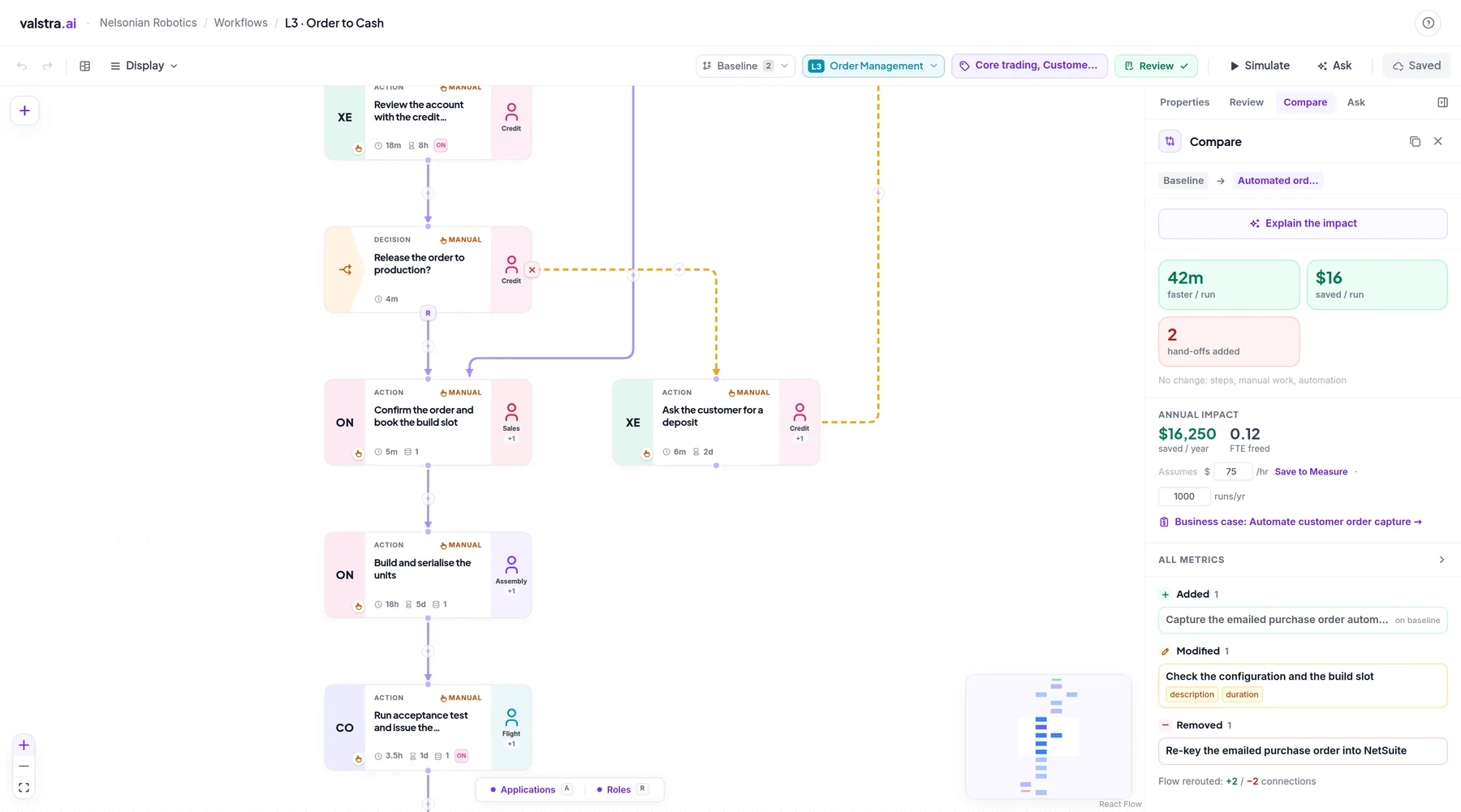
Each proposal is an explicit before and after scenario. Every step, rule, system and data object in the change has to be accounted for, so nothing that still matters goes missing between the old process and the new one.
A case you can argue with
Cost, effort and expected return are attached to the processes the change touches. A modelled figure always displays the assumptions behind it, and Omni never presents a number it was not given or cannot derive.
A specification to build from
The agreed scenario becomes a build-ready specification, with each task traceable back to the plan. Where the build is tracked in Jira, Omni reads progress back from it, so what was delivered can be checked against what was agreed.
What it returned
Expected benefits are set against a baseline before the work starts. Omni records what actually landed, month by month against the forecast, and a month with nothing recorded stays absent rather than estimated.
How does an engagement with Valstra run?
One process at a time, starting from material you already hold. The aim is that your team runs the next one without us.
Start with one process
Pick one that people already argue about, or one a team wants to build an app for. We start there rather than with a programme of work.
We map and cost it with you
Omni builds the model from your documents, transcripts and wiki pages, or from a recording of someone doing the job once, and the gaps it reports become the questions we take to the people who do the work. Then we design the change with you and put its cost, effort and expected return beside it. Sometimes the right change is removing a step, or something simpler than a new app, and we will say so.
Your team builds it on Replit
The build starts from the agreed specification, with the baseline already set.
Read the result and hand over
We read the result against the baseline with you, then hand over the way of working, so the next process does not need us.
Common questions
Is Valstra a Replit partner?
Valstra is listed in Replit’s Solutions Partner directory. Valstra is an independent Australian company, and Omni is Valstra’s own product.
Does Omni connect to Replit?
Yes, through Replit’s MCP connector. Omni supports the Model Context Protocol, so once Omni is added as an MCP server in your Replit workspace, Replit Agent can read your Omni model: the processes an app serves, the steps that use it and the route it goes through for approval. It reads only the parts of the model your organisation grants it, and anything it proposes to change waits for a person to accept it. Omni does not monitor what your builders do. An app your team builds on Replit sits in the model as a system, like any other application you run, linked to the steps that use it.
Who builds the apps, Valstra or our team?
Your team does, on Replit. Valstra works on what to build and how you will know it worked, and the app stays with the people who will own it.
Do we need to be using Replit already?
No. If you are still evaluating Replit, the work can start before the first app is built. Valstra models how your organisation approves software and AI use today in Omni, so each new app arrives into an approval route that is already written down.
Can Omni hold a register of the AI in apps our teams build?
Yes. Omni holds a register of AI uses, each with its purpose, its risk classification, who oversees it and what was approved. An app that uses AI in two ways is two entries, because each use carries its own risk. An entry nobody has classified reads as unclassified, never as low risk. Entries are recorded as uses are identified; Omni does not find apps on Replit by itself.
What does Omni need from us to start?
Whatever you already hold about the process: written procedures, meeting transcripts, wiki pages, or a recording of someone doing the job once with the Process Recorder. You do not need polished process maps or modelling expertise first. Spreadsheets need to be saved as CSV, and audio and video files are not read.
Who is behind Valstra?
Valstra was founded by Mike Bentley and is run from Sydney. Before Valstra, Mike spent seven and a half years at Atlassian, most recently as a Principal Technical Program Manager in AI, leading Inside AI, Atlassian’s internal programme for getting value from its investment in AI. That work included turning a queue of internal AI requests into shared building blocks any employee could use to assemble their own agents, an approach First Round Review wrote up as Atlassian’s “AI LEGO blocks”. That is the position an organisation adopting Replit is in: people across the business building with AI, and a need to do it responsibly.
Bring the process you argue about
We will run it through Omni with you and put the case for the change beside it. You keep the model either way.